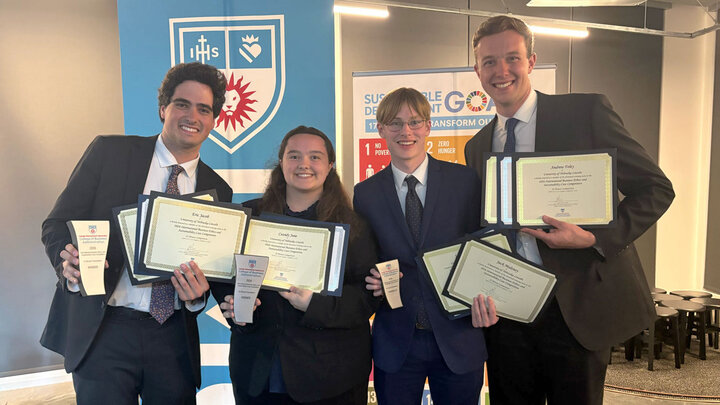
A team of four students from the University of Nebraska–Lincoln College of Business earned first-place finishes in two categories at the International Business Ethics and Sustainability Case Competition. This marked Nebraska’s first appearance in the global competition hosted in Los Angeles by Loyola Marymount University.
Competing against 59 teams from 41 universities across seven countries, the Nebraska Business Honors Academy team won the overall 25-minute presentation and 10-minute ethical deep-dive presentation competitions. The team included Andrew Foley, senior finance major from Lincoln, Nebraska; Cassidy June, senior business and law major from Dorchester, Nebraska; Eric Jacob, senior business and law major from Parker, Colorado; and Jack Maloney, junior economics and finance major from Papillion, Nebraska.
“We created a win-win opportunity where tribal communities gain affordable, reliable electricity while Google benefits from additional energy capacity for data centers," said Foley. "It was probably our delivery and the creativity of our solution that led to our win."
The competition challenged more than 270 student participants to analyze real-world business issues through ethical, financial, legal and sustainability lenses while aligning recommendations with the United Nations Sustainable Development Goals. Unlike traditional case competitions where teams receive the same prompt, students developed their own business problem and solution connected to one or more of United Nations' goals.
The team focused on the growing energy demands of artificial intelligence data centers and energy inequities facing many tribal communities. They created “Recharging Reservations: Bridging the Energy Gap through Tribal Partnerships,” a proposal encouraging Google to partner with tribal nations to develop renewable energy infrastructure that could power both data centers and underserved tribal communities.
“As a team, we wanted to find a problem and an idea that is timely and impacting many,” Maloney said. “At the same time, we saw an opportunity to look inward and identify problems with a direct impact on Nebraska. Relating the problem and solution to our state made it much more grounded and made us more passionate.”
The competition featured three presentation formats: a 25-minute case analysis presentation, a 10-minute ethical presentation and a 90-second sustainability elevator pitch. Students had to adjust their communication styles and strategies for each round.
“It’s very different than any other case competition,” said Erin Burnette, director of the Nebraska Business Honors Academy and the team’s adviser. “It provides students the opportunity to challenge themselves in different ways and utilize different skill sets.”
Burnette said Maloney played a central role in shaping the team’s idea and guiding the project development.
“The insight I gained through competitions hosted at Nebraska had a large impact on our preparation and confidence levels going into this one. They helped me learn how to create strong presentations, improve my public speaking skills and answer high-level questions from senior executives," Maloney said.
The competition highlighted the collaborative culture within the Nebraska Business Honors Academy, even across multiple years of cohorts.
“Despite all of us being in the honors academy, I did not know any of my other teammates well. After spending so much time with them for the competition, I gained three new friends and am proud of our accomplishments," Maloney said.
Burnette said the team’s success was especially impressive because three of the four students competed during their final semester of college while balancing interviews, jobs and graduation preparations.
“It felt like a pinnacle moment," said June. "Everything else was winding down before graduation, and then we went to California, competed together and had this huge accomplishment."
The team’s presentation also made a strong impression on the competition judges.
"Doug Wolf, Uber’s global head of design and construction and the lead judge for Nebraska’s presentation room, connected with the students after the competition. Since then, he worked to help connect our students with Google leaders because he believed the proposal had real-world potential," Burnette said.
The win adds to a strong year for the Nebraska Business Honors Academy in national case competitions. This year, academy teams also won the Washburn University Leadership Challenge and the Purdue University Big Ten Case Competition. All Nebraska Business Honors Academy students compete in at least one case competition before graduation as part of the program’s experiential learning focus.
“Competitions can seem scary, but they are an excellent opportunity to represent Nebraska and showcase the talent we have here," said Maloney.


