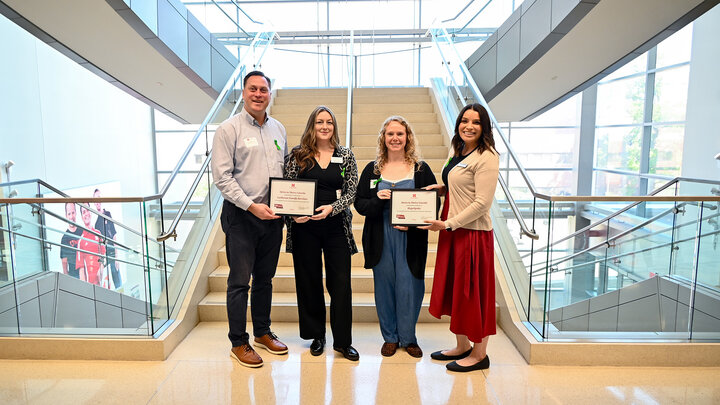
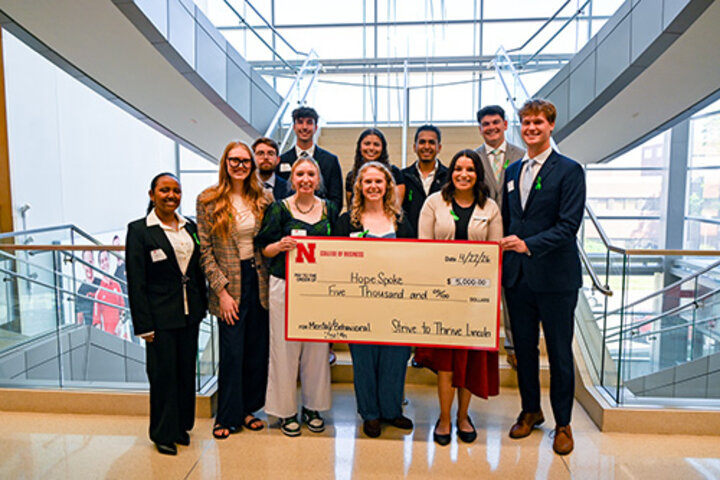
Students in the spring semester Philanthropy and Leadership (MNGT 411) course at the University of Nebraska–Lincoln College of Business awarded $10,000 in grants through the Strive to Thrive Lincoln project to two nonprofits supporting mental and behavioral health in Lincoln — HopeSpoke and Lutheran Family Services.
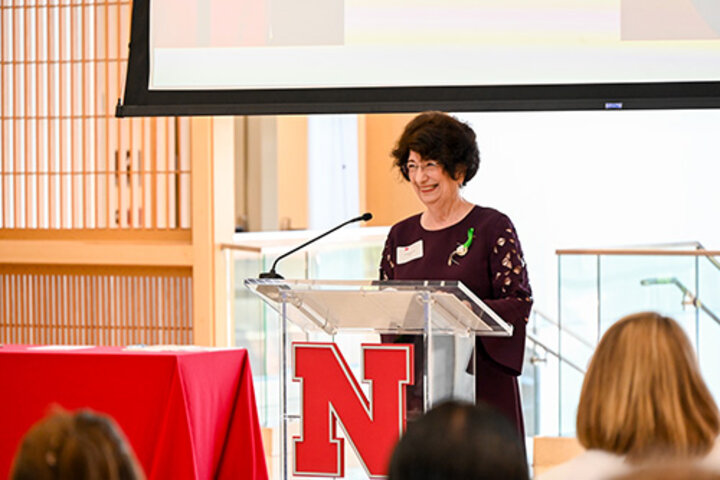
The student-led project, launched in 2015, helps students learn about philanthropy, nonprofit leadership and civic engagement through hands-on experiences with local organizations. Throughout the semester, students evaluated nine nonprofits, conducted site visits, volunteered, reviewed financial information and determined how the grant funding donated by Rhonda Seacrest should be distributed.
This spring, the class focused on mental and behavioral health after reviewing local data showing growing needs in Lincoln and Lancaster County.
“I selected this as our funding priority for the Spring 2026 semester because there is ample data suggesting that this aspect of health is a concern in our community,” said Amber Messersmith, executive director of the Center for Executive and Professional Development and lecturer of management, who teaches the course. “The Lincoln Vital Signs report that we read this spring identified that Lancaster County residents report a growing number of poor mental health days over the last decade, and almost 1 in 5 adults in the county have been diagnosed as having a depressive disorder.”
Throughout the semester, students visited and volunteered with nine nonprofit organizations focused on mental and behavioral health, including: CenterPointe, HopeSpoke, Houses of Hope of Nebraska, Lutheran Family Services, Matt Talbot Kitchen and Outreach, Mental Health Association of Nebraska, St. Monica's, The Bridge and Wellbeing Initiative. Their firsthand experiences helped them gain a deeper understanding of the challenges nonprofits face.
"This opportunity allowed us to see the incredible work being done every day for our community and gave us a greater understanding of what a day in their shoes supporting mental health looks like," said Bailey Taylor, senior Clifton Builders management and marketing major from Fremont, Nebraska. "We also learned to break down ideas that address real challenges like whether there is ample access to care, reducing the stigma surrounding mental and behavioral health, or strengthening community resources."
Seacrest, whose support funds the grants each semester, encouraged students to carry their philanthropic mindset beyond the classroom.
“Coming here a couple of times a year to meet with the students of this class is one of the highlights of my year because you are very special people,” Seacrest said. “The decision you make to take this class speaks volumes about each of you. You have determined there are needs in the world that need to be addressed, and by using what you've learned in this class, you can help alleviate them.”
Students announced the grant recipients during a celebration highlighting the work of all nine nonprofits and reflecting on what they learned throughout the semester.
Ryan Lamson, senior accounting major from Omaha, Nebraska, said HopeSpoke stood out because of the wide range of services it provides children and families.
“They don’t just offer one solution. They meet children and families wherever they are and continue to support them as their needs evolve,” Lamson said. “What stood out wasn’t just the structure of the program, but the environment. You could see the relationships the staff had built. It felt supportive, safe and genuinely caring.”
HopeSpoke will use its grant to support repairs and upkeep at one of its therapeutic group homes for youth. Students visited the group home during the semester and interacted with residents. Following the visit, one youth told staff that talking with the Nebraska students “made him feel human.”
“I remember touring one of HopeSpoke’s group homes for adolescent boys and listening to their stories,” said Hallie Little, senior management major from Lincoln. “I was reminded that these boys are just normal kids who grew up in unfortunate circumstances, and I’m beyond grateful for the resources HopeSpoke can provide to some of Lincoln’s most vulnerable.”
Maggie Montoya, development director at HopeSpoke, said the student engagement was just as meaningful as the funding.
“While this grant is definitely the cherry on top, it was really meaningful not just to us, but to the kids you served,” Montoya said. “You gave them an experience where you got to know them, and they loved it.”
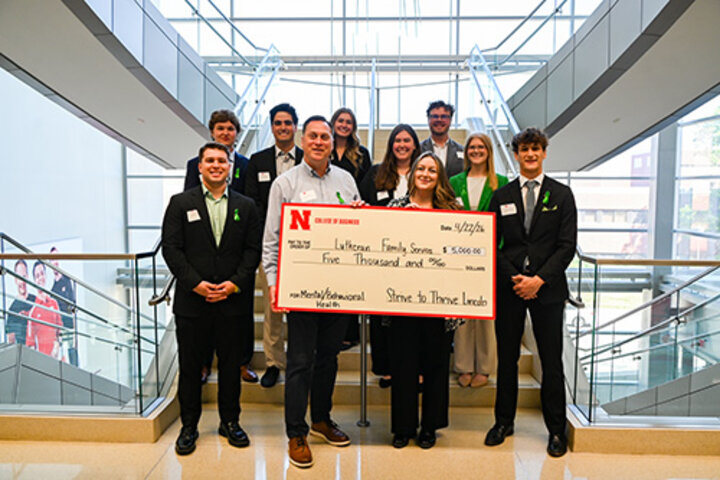
Lutheran Family Services plans to use the grant to support its new Crisis Intervention Center, a 24/7 urgent care-style facility for individuals experiencing mental health crises. Located at its O Street facility, the center will offer observation, crisis support, mobile response and connections to additional mental health resources.
Matthew Wegman, junior accounting and Clifton Builders management major from Seward, Nebraska, said learning about the new center left a strong impression on him.
“Knowing that Lutheran Family Services is working to create a way for someone to always be available to help individuals in their most difficult moments really showed me the impact this organization has, and is going to have for generations to come," Wegman said.
Joel Stoltenow, who accepted the grant on behalf of Lutheran Family Services with Heather Wiese, said the center addresses a critical gap in care.
“Anyone can walk through the doors of this Crisis Intervention Center,” Stoltenow said. “If you’re having a rough day and you’re in crisis, you can walk through that door. That’s something that wasn’t provided before, and you’re helping us build that.”
Wiese said the center will provide flexible, immediate support for individuals who may not need hospitalization but still need help navigating next steps.
“There are a lot of resources in our community, but there’s a gap for that 24-hour access when you don’t know what you need. Having somebody you can walk in and talk that through with — whether it’s 30 minutes or overnight — is what we’re trying to build.”
Now in its 19th iteration, Strive to Thrive Lincoln builds on experiences like these to give students insight into philanthropy, nonprofit management and community engagement.
“This class has given me the opportunity to learn more about the city I grew up in,” said Peyton Wilson, senior marketing major. “After my time working on Strive to Thrive Lincoln, I aim to volunteer at more nonprofits here in town to further explore the place I call home, because I learned that just a couple hours of service can go a long way.”


