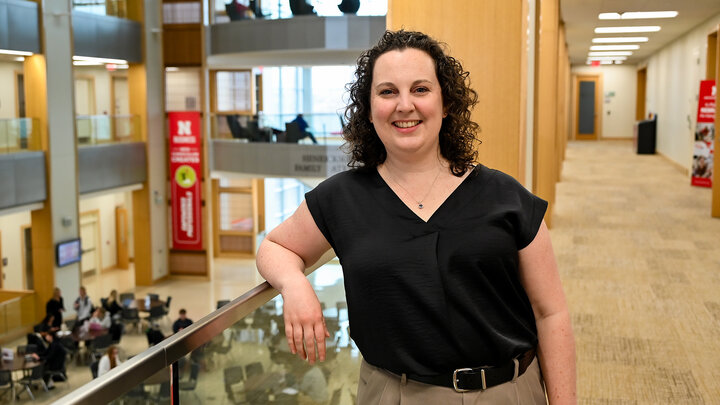
The National Bureau of Economic Research (NBER) has awarded University of Nebraska–Lincoln doctoral student Rebecca Jack a 2025–26 dissertation fellowship through its highly selective Gender in the Economy program.
The fellowship provides funding and mentorship to advance Jack’s research examining how access to after-school care affects parents’ ability to participate in the workforce. Each year, the program selects only three fellows from a national pool of doctoral students, typically representing institutions such as Harvard, MIT and Yale.

“It’s incredibly validating to be selected,” she said. “A Ph.D. in economics is something I always wanted to do, and studying gender, families and children is something I care deeply about. To receive recognition like this makes me feel like the leap to pursue this path was worth it.”
NBER is one of the world’s leading nonprofit economic research organizations. Its Gender in the Economy program is directed by Claudia Goldin, a Harvard University professor who received the 2023 Nobel Prize in Economics for her groundbreaking work on women’s roles in the labor market.
As part of the fellowship, Jack attended the NBER Summer Institute in Boston, an invitation-only conference that convenes many of the world’s top economists. She participated in research sessions focused on gender and the economy and met with mentors including Goldin and Dartmouth economist Claudia Olivetti.
Jack’s research focuses on a question that affects millions of working families but has received relatively little scholarly attention: what happens after the school day ends.
While most child care research centers on early childhood and education studies typically focus on the school day itself, the hours between school dismissal and the end of the workday remain largely unexplored.
Jack’s project examines how the availability of after-school care programs influences parents’ ability to work. Many such programs operate for only a few hours and are often housed in school buildings, making them relatively inexpensive and scalable.
“If access to these programs allows parents to work more and earn more, there could be substantial benefits,” Jack said. “It’s an area where expanding what already exists could make a real difference for families.”
The research also leverages unique data resources available at Nebraska. This includes the U.S. Census Bureau’s Research Data Center located on the university’s campus, which allows researchers to work with highly detailed restricted data.
Brenden Timpe, assistant professor of economics and Jack’s adviser, said the fellowship recognizes both the importance of the topic and her approach to studying it.
“The cost and quality of child care are on the minds of a lot of families, businesses and policymakers these days, but solutions have been really hard to find,” Timpe said. “Becky is taking on these big, important questions in a creative way, and this award reflects the fact that her ongoing work has the potential to make a big impact.”
Jack has built a network of collaborators and mentors, including Timpe and Daniel Tannenbaum, associate professor of economics.
“Becky is an outstanding researcher, and we are lucky to have her as a Ph.D. student at Nebraska,” said Daniel Tannenbaum, associate professor of economics. “Her research stands out for its originality and for leveraging the strengths of the data resources on UNL’s campus. During her Ph.D. studies, Becky has built an impressive portfolio of projects with collaborators across institutions.”
Tannenbaum, a recent recipient of the Faculty Early Career Development (CAREER) Award from the National Science Foundation, noted the importance of Jack's fellowship.
“NBER fellowships are highly competitive, with applicants from the most prestigious institutions in the country, and only a few Ph.D. students receive them each year. This is an exceptional achievement for Becky and for the university.”
For Jack, the recognition also reflects the many people who have supported her work — from faculty mentors and collaborators to a strong personal support system. She noted how balancing doctoral research, conference travel and family life requires coordination and support.
“It really takes a network,” Jack said. “My husband has been incredibly supportive, and we’ve relied on so many people from family, neighbors and colleagues, and the Department of Economics here has been amazing. You need people in your corner, especially at the beginning of a career.”
Jack plans a future in higher education following her time at Nebraska.
“I’d love to be a professor,” she said. “I enjoy working with students, teaching and doing research. Being a professor lets you pursue all of those things.”