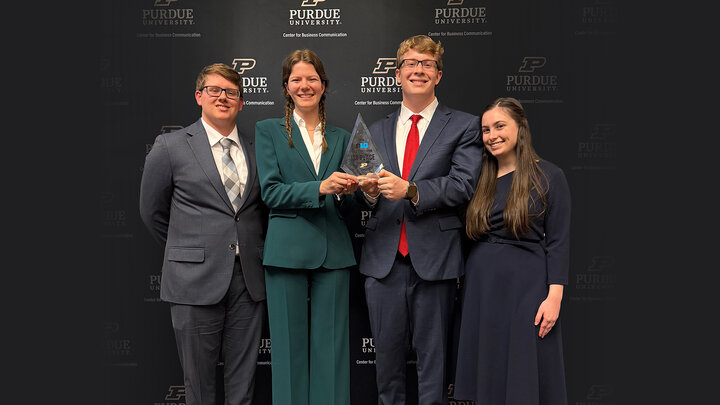
A team of four students from the University of Nebraska–Lincoln College of Business Honors Academy earned first place at the 2026 Big Ten Case Competition on Feb. 6 at Purdue University in West Lafayette, Indiana.
Nebraska advanced to the final round alongside teams from Indiana University, University of Michigan and host Purdue, marking its first appearance in the Big Ten Case Competition.
“The case challenged them to create recommendations for a workforce development plan for women in the semiconductor field,” said Becka Neary-DeLaPorte, assistant director of the Nebraska Honors Academy, who traveled with the students. “They were successful because of their in-depth research. They addressed large barriers such as workplace climate, gender imbalance in STEM and life-course friction, and developed significant recommendations grounded in data and research.”
The winning team included seniors Kris Roberts, accounting major from Omaha, Nebraska, and Savannah Miller, actuarial science major from Lincoln, Nebraska, along with sophomores Grant Meisgeier, accounting major from Omaha, and Dylan Asmus, actuarial science major from Omaha.
“We were intentional about making sure our solution was clear, practical and easy to follow,” said Miller. “A big part of our success was creating a positive team dynamic. Having fun together made it easier to share ideas and work through challenges under pressure.”
One recommendation focused on implementing “returnships,” structured programs designed to support professionals reentering the workforce after time away for caregiving responsibilities.
Preparation began immediately after the case was released on Jan. 31. The team refined its strategy through practice presentations with fellow Nebraska Business Honors Academy students and incorporated feedback throughout the process.
“Thanks to the relationships we developed among team members, we maintained a lighthearted attitude while prepping for the competition,” Roberts said. "It's important to have fun."
Neary-DeLaPorte shared how all Nebraska Business Honors Academy students must compete in a case competition before graduation.
"This requirement is intended to give students an experiential opportunity to apply what they are learning in the classroom to industry. Each spring we take between 20-24 students all around the country to compete. The case competition topics vary, and the teams are always randomly assigned," she said.
Roberts and Miller encouraged other students to participate in case competitions, noting the experience allows students from different academic backgrounds to collaborate, share ideas and learn by doing.
"This case wasn't focused on accounting, but I was still able to contribute my perspective and help develop a solution," Roberts said.
Miller added that the competition strengthened team dynamics.
“While Kris and I had worked together before, this was our first time collaborating with the rest of the team. We created a positive environment where everyone felt comfortable sharing ideas and giving feedback,” Miller said. "One of my favorite parts of this experience was how much fun we had as a team while still working hard toward a common goal."
Neary-DeLaPorte said the competition offered a realistic preview of professional expectations, from teamwork and research to presenting under pressure and receiving direct feedback from industry leaders.
"Having the opportunity to work and compete with our Big Ten peers is always a fun, competitive environment. Case competitions give students the opportunity to showcase their academic talents and leadership skills," Neary-DeLaPorte said. "Prepping for a case competition simulates the real world with teamwork, research and presentation in a week, which is as close to industry as we can provide students."