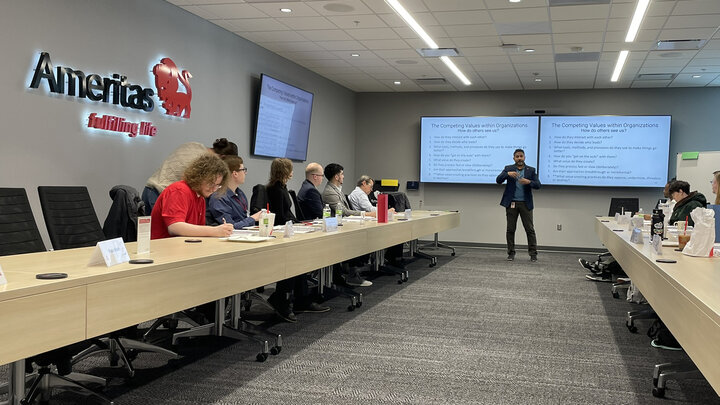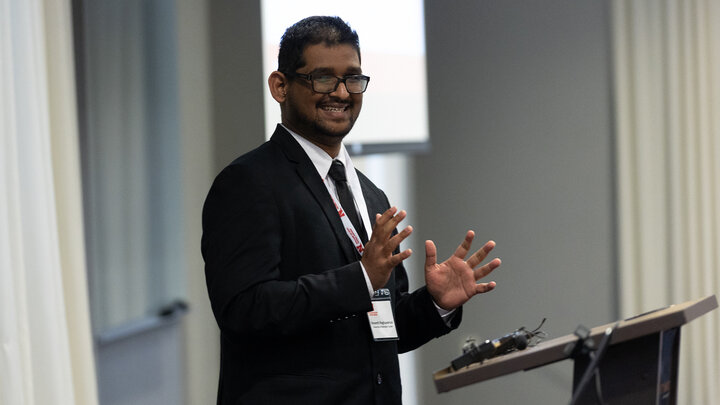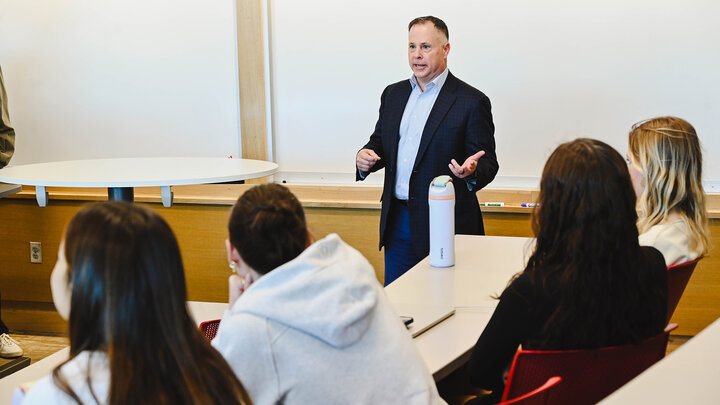
Kris Grosshans, '85, returned to the University of Nebraska–Lincoln to discuss ethics and share his firsthand experience with one of the most notorious corporate collapses in American history: Enron.
"I'm a bit self-conscious about sharing it as it happened 25 years ago, before you all were born," Grosshans told an auditorium of students. “Yet it’s a milestone in the history of U.S. business. The bankruptcy of Enron resulted in a host of legislative, accounting standard and legal changes. The books on business were rewritten because of Enron in an effort to keep it from happening again. It's important remember and learn from history because people will find ways to bend the rules."
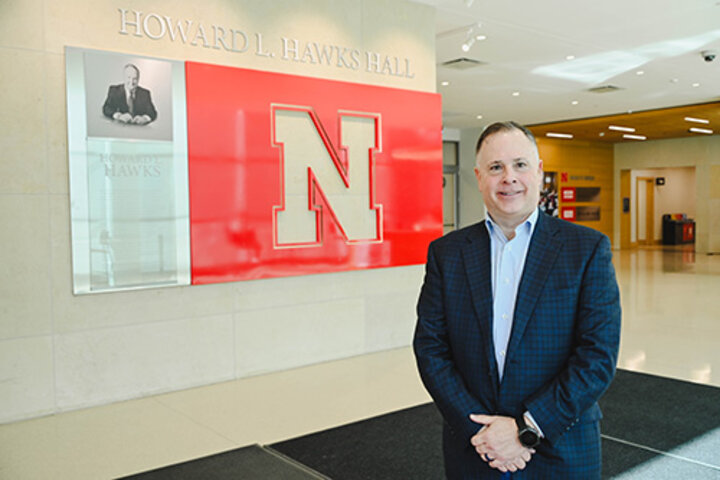
A first-generation college student from Central City, Nebraska, Grosshans earned his degree in finance and now lives in Chicago. He works in New York City and travels extensively in his role as managing director of Power, Utilities and Infrastructure Banking at Mizuho Securities.
In the simplest terms, he said, his job is to sell corporate and investment banking products and services — everything from lending to advising on mergers and acquisitions and raising equity capital or debt capital.
But 25 years ago, Grosshans was a young banker when Enron unraveled. The Houston-based energy giant was his bank’s largest U.S. client.
"For six years in a row, it had been voted the most admired company in the world," he said. "Questioning it felt almost unthinkable."
Increasingly, as he and his team analyzed Enron's financial statements, they began making internal “add-backs,” reintroducing debt that Enron had structured off its balance sheet.
“We surmised that the add-backs were so substantial that the company had two to three times more debt than it showed in its financial statements, and we didn’t even know about everything," Grosshans said. "At the same time, this was the largest client we had in the United States, and I was a young banker. My management asked if I knew more about the situation than the equity analysts and the big accounting and law firms. You start questioning yourself. Do I really know?”
He told students that ethical failure rarely results from a single dramatic misstep but from small compromises that accumulate over time, enabled by flawed corporate culture.
“There wasn’t a point in time when the company went from good to bad. It was a slope where it just got more and more slippery," Grosshans said. "This company just spun completely out of control through a series of bad decisions and business practices.”
Most people caught in the collapse, he believes, were not villains.
“The vast majority of the people who worked at Enron were good, very smart people,” he said. "They were part of a culture that was broken, and there were a few bad apples."
Grosshans also highlighted the letter that Sherron Watkins, who was vice president of corporate development at the Enron Corporation at the time, wrote to then CEO Ken Lay, warning of accounting irregularities.
"Watkins took enormous personal risk before there were the whistleblower protections like those that exist today. It was a very brave thing for her to do,” he said. "She has a powerful story that students need to know, and it's just as important today as it was 25 years ago."
Emma Higgins, senior supply chain management and Spanish major from Prior Lake, Minnesota, and president of the College of Business Student Ethics Board, said the Enron story resonated with her.
“Students in college haven't experienced a high-stakes situation like that. It’s important to know that just because something isn’t illegal doesn’t mean you should do it. You need to watch yourself,” Higgins said.
Kathy Farrell, James Jr., and Susan Stuart Endowed Dean of the College of Business, invited Grosshans back to campus to share the Enron story with students and noted that it was fitting he did so in Howard L. Hawks Hall.
“I’m grateful to Kris Grosshans for guiding our business students in exploring ethics with clarity and purpose,” Farrell said. “By doing so, he also paid tribute to Howard and the values he championed.”
Grosshans crossed paths with the late Hawks through both the university and the energy sector. He said he admired the Omaha businessman who co-founded Tenaska and served as a University of Nebraska Regent.
"I have so much respect for the business he built and his commitment to doing things the right way. I also admire his philanthropy and his desire to give back so significantly to others," Grosshans said.
That spirit of stewardship motivated Grosshans and his wife, Barbara, to serve as trustees for the University of Nebraska Foundation. It also inspired him and his fellow members of the Finance Advisory Board to raise money for student scholarships each year.
"It's about the next generation of students and what we can do as interested and passionate alumni. We want to help them have the best possible experience in the business college and foster the same passion, so they want to give back," he said. "That's why it's important to come back and spend time at the college in meaningful ways."